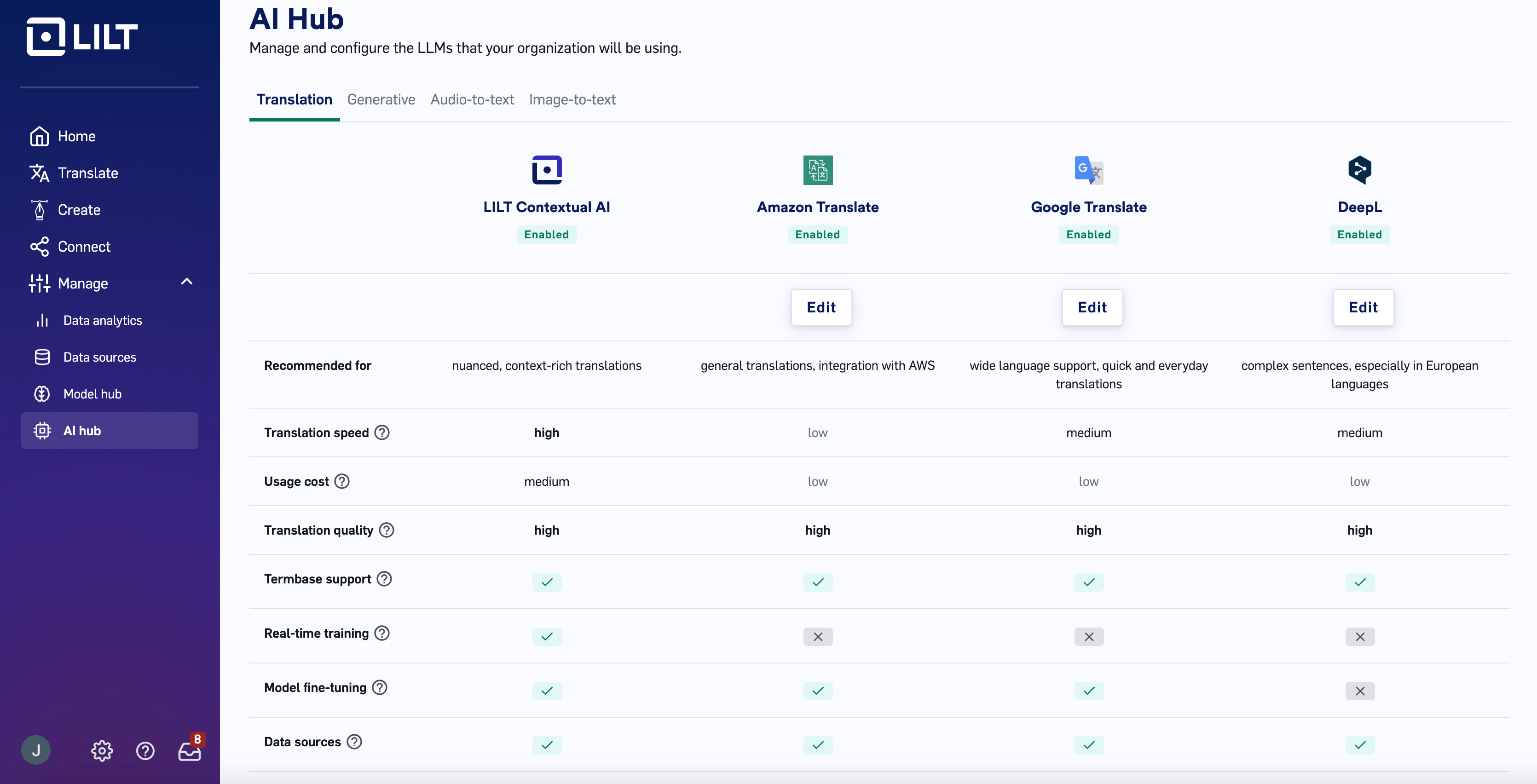

- Integrate with Google Translate and pull Google Translate content into LILT
- Deploy Google Translate content in workflows
- Send training data back to Google Translate for fine-tuning
us-central1 region — all Google-side model resources are created there, and fine-tuning is only available for this region. Once this is complete, a user navigates to LILT Model Hub to create a Google model. Creating a model in LILT sends a request to Google’s Cloud Translation API to create a custom translation model (this capability was previously built on Google’s legacy AutoML Translation API, which Google retired in September 2025; LILT’s integration now uses Google’s current Cloud Translation Advanced/v3 API for the same custom-model training). If the user desires, they can send bilingual translations stored in LILT to fine-tune the Google model. A fine-tuned model will produce translations which are more contextually accurate to the bilingual training data.
Once a Google model is created within LILT, it can be used for translating documents and in LILT’s AI>Review workflow. The translation of documents will use an API call to Google to complete a document translation. The AI>Review workflow is similar, but different in that the translated document is parsed into LILT’s CAT editor, where a reviewer can go through and make post-editing modifications as needed.
For more information about LILT third-party integrations and Google specific credentials see the following LILT knowledge base entry:
Appendix A: Google Translate Orchestration in LILT